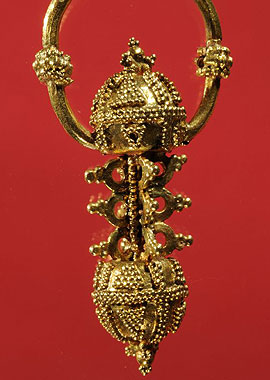
Locality „Na Valách“ in Staré Město
The locality „Na Valách“ surrounded in an irregular oval a hill at the end of the northern Staré Město promontory and represented the central archaeological site in Staré Město conurbation. Amateur research of the locality „Na Valách“ was carried out as early as the 1880s (František Myklík, Martin Kříž, Ignác Tkáč) near a water mill which then stood there and in the neighbouring gardens. In 1897, following the opening of so-called Klečka’s sand mine, Great Moravian skeleton and cremation graves whose number is hard to estimate were damaged. A rescue research was, however, not commenced until 1924 when teacher Antonín Zelnitius explored a Great Moravia burial site for about a decade. A real systematic archaeological research is attributed to Vilém Hrubý, a curator of Slovácké Museum in Uherské Hradiště, later an archaeologist in Brno Moravian Regional Museum who started his research in 1948. Vilém Hrubý conducted research in Staré Město excavation site till his death in 1985. His continuator Luděk Galuška of Moravian Regional Museum follows up with his work till today.
The proof of the extremely old settling of the location „Na Valách“ are finds of early paleolithic flintstone tools – blades and their splinters. The late paleolithic period is documented by a skeleton grave of a woman with stone tools and a fireplace in the proximity. Further settling is represented by settlement hollows from linear ceramic culture and from the times of Moravian decorated culture along with the characteristic ceramics discovered consequently in the backfill of Slavonic graves, and by the characteristic sharpened flintstone tools. The locality was not inhabited then and researches indicate the existence of a small settlement in Luzice urn field culture of Early Bronze Age. The settling after this culture is associated with the coming of Slavs to our lands, i.e. at the beginning of the Christian era.
As early as the second half of the 8th century the settlement assumed importance and was surrounded by palisades and moats as fortification. The research of grave holes proves that even before the rise of Great Moravia there lived people of noble origin who maintained contacts with abroad. In the 9th century, in Great Moravia period, the function of the locality „Na Valách“ changed – the local fortification ergo the settlement itself disappeared (around mid-9th century) and a grout-stone church was built here. The church, rather the outline of its foundations, was discovered by V. Hrubý in 1949, which was no doubt the first discovered Great Moravia brick church. Originally, a local burial ground turned into a necropolis of the old Staré Město conurbation. Buried here were not only members of Great Moravia nobility with their rich equipment, weapons and jewels but also poor people, farmers and craftsmen. The church started to decay around the early 10th century and some time later also burying was gradually discontinued, presumably due to the decay of Great Moravia. The area „Na Valách“ was not re-settled until the early 13th century when Cistercians were building their monastery near today’s Velehrad intending to set up their base out of the remains of the old Great Moravia‘ s Veligrad.


 RSS akce